
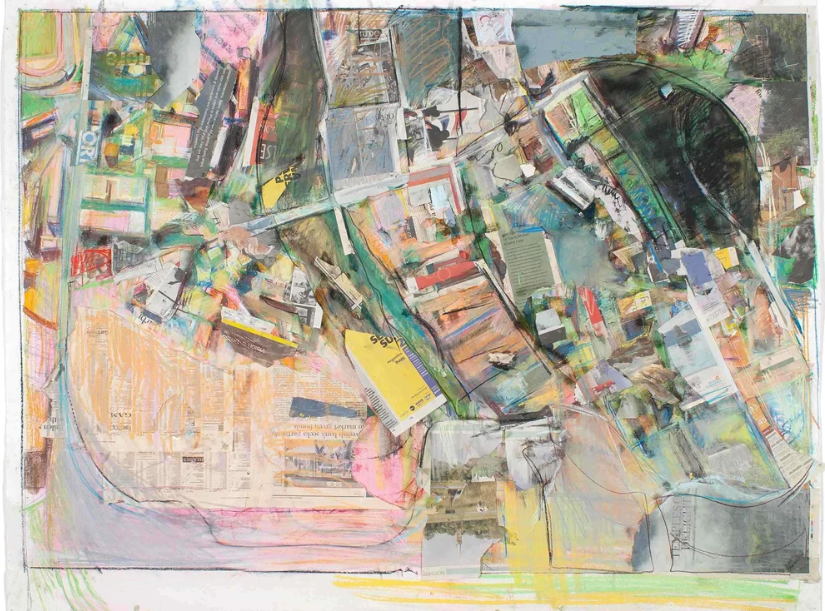
Aerial Rhythm (Malaga Drawing) (2010-2011), chalk pastel and newspaper on paper, 4’x 5’
Last month, I met artist Toby Messenger at his solo exhibition Plein Soul at Iota in Glasgow, a show that brought together over 20 years of drawing, painting and sculpture, arranging a life of keen looking and making.
The exhibition’s title departs from the traditional method ‘plein air’, the practice of painting landscapes outdoors. Instead, Plein Soul offered relics of commercialism wonkily recreated by the artist’s hand: a fighter jet and a car constructed from repurposed materials like styrofoam and plastic; cans of Diet Coke and a TV roughly reassembled with cardboard and soft pastel. Landscapes of familiar objects reinterpreted through the artist's perspective, and at the mercy of his instinct.
Originally a painter studying at Glasgow School of Art, Toby’s practice began as observational and pictorial, drawing from the environment that surrounds him. These works, quite traditional in their approach, adhere to the term ‘picture plane’, a foundational term in art language where the artwork is framed by the artist’s perspective, contained as if viewed through a window. Over the course of his practice, however, Toby’s work seemed to become increasingly concerned with shattering this window- as I walked through the doors of the gallery, I was confronted by Aerial Rhythm (Malaga Drawing) (2010-2011), an aerial map pieced together with newspaper clippings and scrawls of soft pastel. Looking at it from a distance with squinted eyes, the work resembled a normal map. At a closer glance, it began to pulsate as I noticed the tiny fragments that made it up. In this work, scale is distorted through collage: an image of cows in a field becomes miles of land; a cropped photograph of rainforest becomes a marker for an entire area of trees; a section of someone’s head is the size of a village. The work is dense and alive, vibrating against the edges of the paper.
“I’ve always had a problem with edges,” Toby said, standing across from his work. He shared a memory from a previous residency, when a director bounced into his studio, exclaiming, “I’ve been thinking about your work and I realised what’s wrong with it. You don’t consider edges!”. Toby proposed otherwise:
“I don’t think it was [that] I don’t consider edges. It was more that I’m acutely aware of the environment or parameters [...] I’m working in, so the relational activity bleeds out and finds its own parameters. [...] There’s an important distinction there.”
Other examples of Toby’s relationship with parameters exist on his website, one being Homage to Velasquez (After La Tela Real) (2015). In this work, the surface grows appendages. Photographs, collage and soft pastel drawings extend out from the edges
of a sheet of cardboard, forming a jagged shape. The cardboard itself precariously rests on the wooden bars of a deconstructed frame. Later on, when I messaged Toby to ask about this work, he replied:
“Thats an interesting one. That’s when I started using cardboard in earnest. [..] The frame supporting the work became part of that and it got a bit meta… I’m fond of that one. Yes- that’s I guess something along those lines [edges]. I let the work frame itself.”
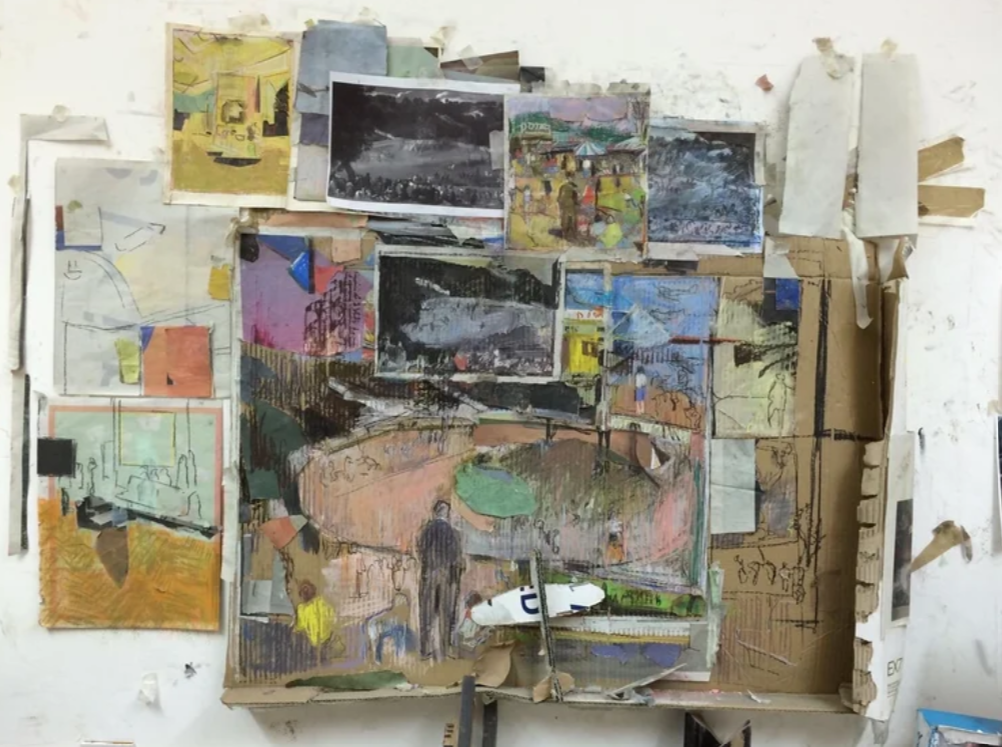
Homage to Velasquez (After La Tela Real) (2015), chalk pastel and collage on cardboard, mounted on wooden frame
This got me thinking about the relationship between his sculptures, which are freestanding objects, and his paintings, which have borders to consider. Cop Car/Ford Capri (2025) is a half-collapsed looking, knee height American cop car that sat across from Aerial Rhythm. I remember noting that it looked urgently built, and asking him how he made these types of works: are they created gradually over time, or in long stints? He told me that he works in intense, sustained bursts, likening the process to the act of drawing: “[...] you sort of know: ‘that’s done’. You don't need to do any more to it- you move on. It’s very much a similar process”. I looked over at Aerial Rhythm and imagined
Toby’s cars bursting out of its surface at night. His sculptures are like escapees from a painting.
What particularly interests me about Toby’s sculptures is that the materials which come to form them differ in their qualities and origins. I’m aware that I risk sounding overinterpretive by bringing attention to the fact that each material, each piece of plastic in Cop Car/Ford Capri has its own maker, its own history. I know that almost every human made thing we come into contact with is built in this way; each material or ingredient having come from multiple suppliers, originating in a different factory. But, there’s something in the way that Toby’s works don't attempt to conceal their fragmentary nature that implores me to meditate on that idea a little longer than I would if I was looking at a real Ford Capri. I am filled with a peculiar feeling that I’m looking at a vignette of civilization.
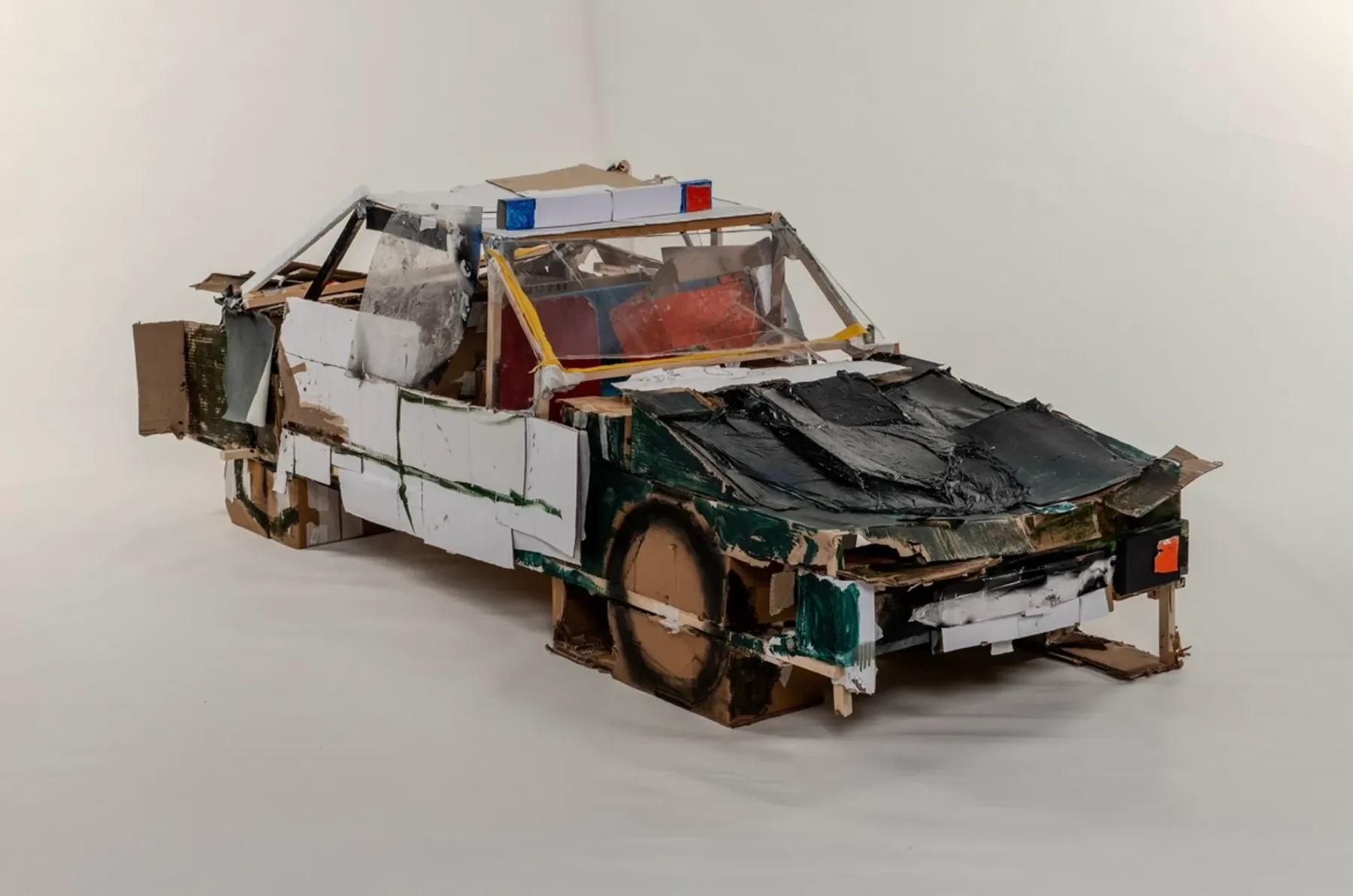
Cop Car/Ford Capri (2025), Half scale cop car, mixed media, reclaimed wood, cardboard, packaging, paint and Perspex
To me, Aerial Rhythm feels like a bridge between a single point of view and the collective one; by surpassing the limited human ability to see through one set of eyes, and instead enacting multiple perspectives all at once, it sets a backdrop for Cop Car/Ford Capri and other works like it; patchworks of various materials made by multiple
people from different walks of life, stitched together by one hand. Through this process, the works become an amalgamation of otherwise separate lived encounters, where individual experience and collective reality coexist: the artist’s inner world, and the external one that surrounds him.
The car is an emblem of the material world. Toby’s reconstruction of it feels alive and human. A palpable friction exists in his sculptures between animate and inanimate, human and machine. The feeling of dystopia is hard to shake as you walk amongst them; they’re like evidence of a collapsed world which has been rebuilt with its own remnants. There’s a sense that you’re standing in a scrapyard of memories, objects fabricated as a way to record time, to leave a mark or a message: “We existed!”. Echoes of humanity persist, not only through replication, but through the materials themselves. These things as concepts: car, bike, turntable, glass bottle– when extinct, will be survived by their components.
Thank you, Toby, for taking the time to speak with me! Toby’s work can be found on his instagram, @_toby_messenger, and his website: tobymessenger.co.uk
