
Interview: C.U.L.T Life Drawing | Bethany Watt
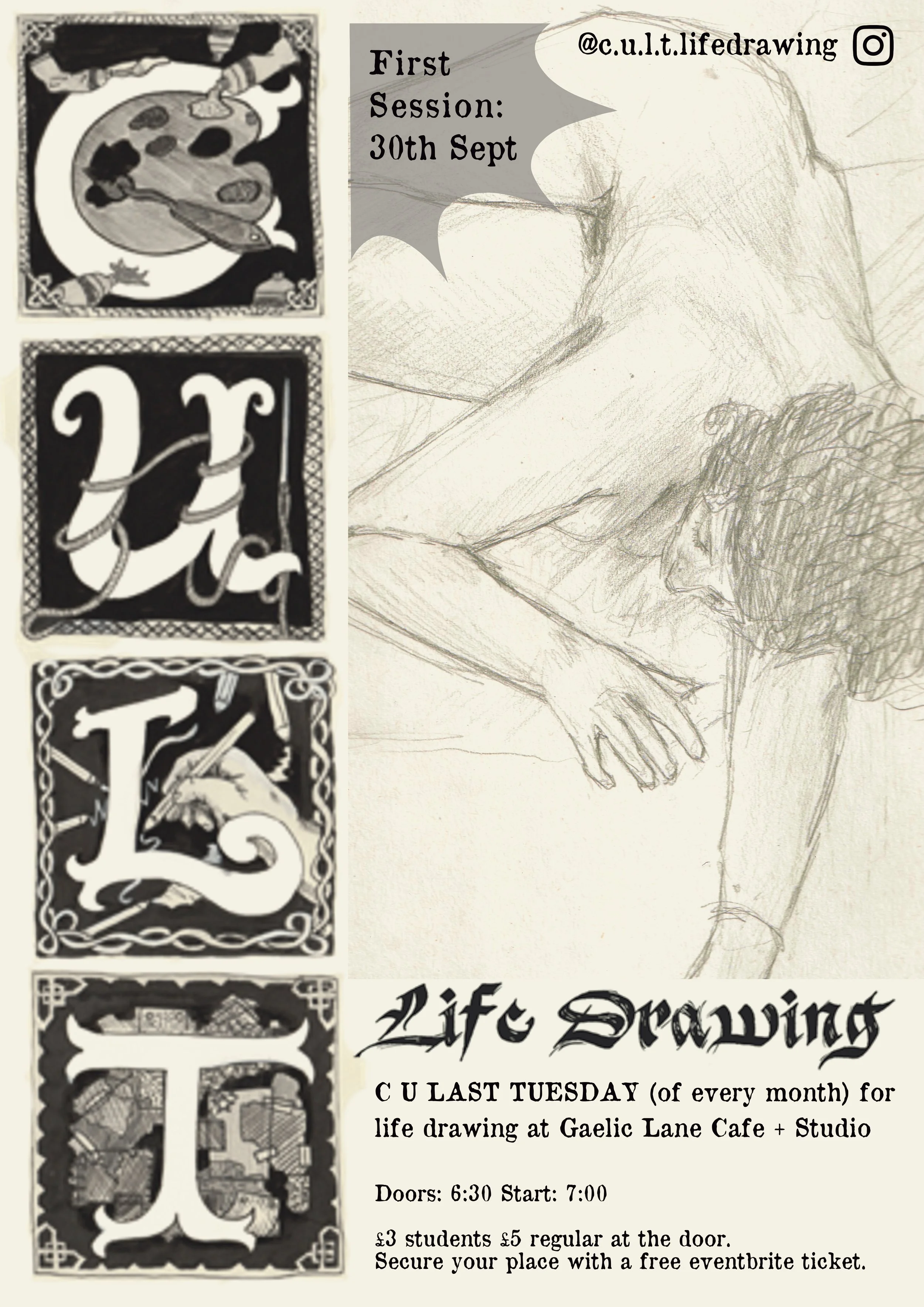
Poster by Vanessa
C.U.L.T (C U Last Tuesday) is a life-drawing collective that hosts accessible classes for working-class artists in Aberdeen.
Join me as we discuss the stigma around the naked body, the inherent classism around drawing it, and the message of resistance and empowerment it reinforces.
I was thrilled when Vanessa and Lucy agreed to answer some questions, as the Deputy Editor of an arts magazine, life drawing has always been an interest of mine and something I want to learn more about. Unsurprisingly, I haven't been able to find, let alone attend, a nearby class to write about.
Although I can’t join a C.U.L.T class any time soon, this conversation has given me every bit of information I need to know before going. I hope you enjoy Vanessa and Lucy’s answers, filled with a very clear passion, as much as I did.
Are you ready to join the C.U.L.T?
Q: Tell me a bit about yourselves, what do you do?
Vanessa: (she/her) I am a queer street artist from Aberdeen, I draw big sparkly feminine women mostly. I did Communication Design at uni, but marketing/graphics by itself is not something I am passionate about. I like applying those skills for things I care about, such as cult.
Lucy: (she/her) I am an endurance artist/abstract artist, basically meaning I lock in on long processes to create my work, it is akin to performance art. I have an art historian background, and I have just started my practical art journey after finishing university.
Both: We met through an artists’ collective called Growing Pains, we developed a lot as artists during our time with them and realised we worked well together.
Within Growing Pains we put on exhibitions and events that did really well. Lucy put on “Pride and Paper” which was an open space during Pride for people to destress and create, with Growing Pains. There was one guy who came in and just sat by a table in the corner with headphones on for an hour. Kids came in to do a colouring page of two with their families… overall it was a quiet event but effective as that was the goal.
Together, we focus on affordable community events, with our life drawing.
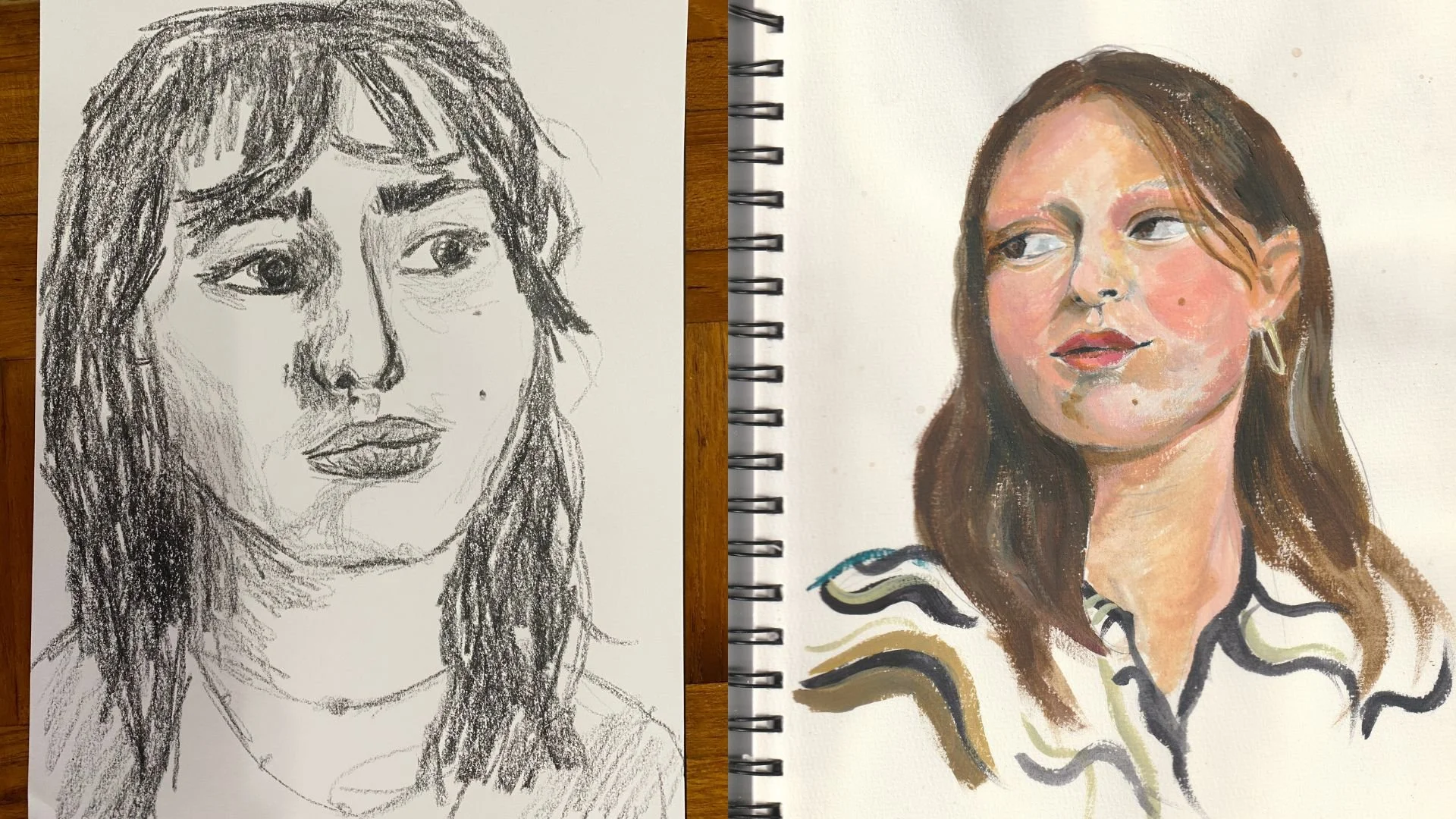
(Left) drawing of Vanessa by Lucy, (right) drawing of Lucy by Vanessa
Q: How did C.U.L.T begin?
Vanessa: By accident. Growing Pains kindly offered their space to Gallowgate Life Drawing. Lucy and I volunteered to lead it when they were sick and we enjoyed it. This was Lucy's first ever life drawing class and I showed her the ropes of life drawing. Then speaking with Gallowgate, we kind of took on the role and were able to rebrand as CULT. CULT stands for C U Last Tuesday, as we host events on the last Tuesday of every month, a pun on C U Next Tuesday (the name idea came from Vanessa’s partner). We play with the idea of cults and call people who attend our sessions ‘cultists’, as an early quote from Lucy during the setup stages states: “Because what else would you call a group of people sitting around a naked person?” From there, the name stuck. Gallowgate life drawing was one of the most well-known life drawing classes in Aberdeen, but the original venue (the Blue Lamp) closed down, and the original organiser also felt it didn’t fit with her life anymore.
Lucy: Vanessa uses her graphics background to do the branding, which I feel is very distinct. She can also create graphics within the cult aesthetic which has been fun. We would describe the aesthetic as “dark academia, celtic, middle ages, ritualistic…” There is a high contrast between the colours and the juxtaposition of the simplistic stick figures and intricate Celtic designs.
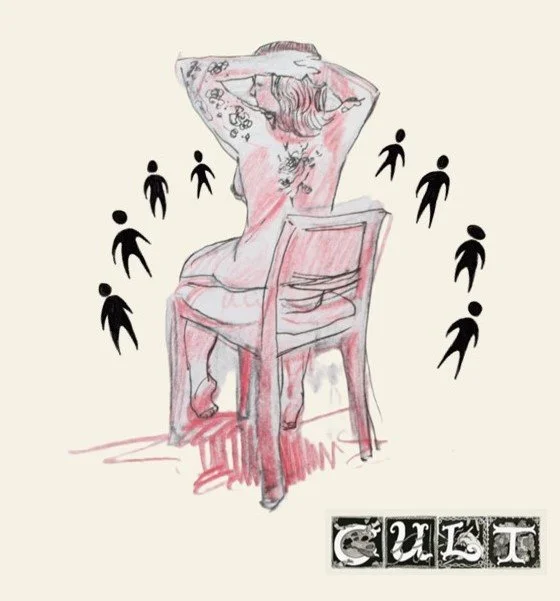
Drawing by Jules Hunter
Q: What is the process/experience like for models who volunteer?
Both: If we don’t know them, we meet them for coffee, as getting naked (or close to being naked) is quite vulnerable, and we want them to know us beforehand to be more comfortable. Also, it gives them the chance to ask us questions, admit their worries, and we try to accommodate them as much as possible. We happily have people who have never modelled before, so these coffees are a way for them to understand what takes place and what to expect during one of our sessions.
During the sessions, we start with short warm-up poses to ease beginner models into posing. It's also great for attendees to warm up their drawing muscles. The models get over the initial shock at this point, and by the time we get to our 25min poses, they are relaxed and almost sleeping.
At the end, the model gets to look around the room and see everyone’s drawings, lots of them find that very fun, and it creates fun conversations and builds a sense of community.
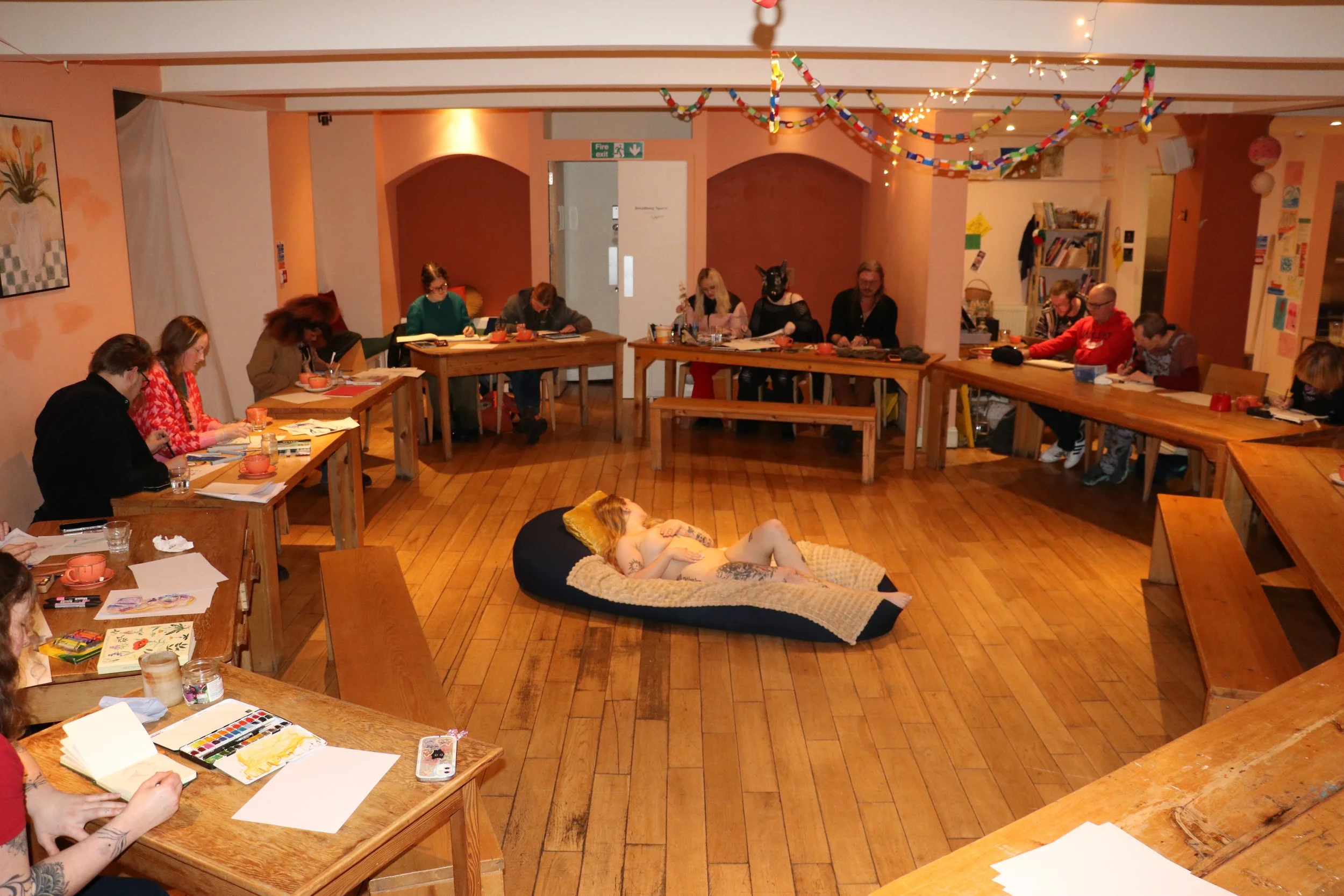
CULT class
Q: How have your classes been received so far?
Both: We are coming up to our 6th this month (March). We started in September and took December off.
We feel like they have been received well, and we started to notice regulars coming, which has been ace. The regulars are at all skill levels, so we are happy lots of people find our sessions accessible to learn, but also refine and practice. We have had people whose first experience with life drawing is with us, and others who haven’t been to a life drawing session in years, and all have told us they have had a fun time. We have also sold out every single session, so we must be doing something right.
We also feel like there is a gap in Aberdeen of sober evening activities, so this may also be a reason for our success. Although… because we keep selling out events and the cafe has a new bar, we may be creating specific boozy events too. We may or may not have a really fun theme lined up.
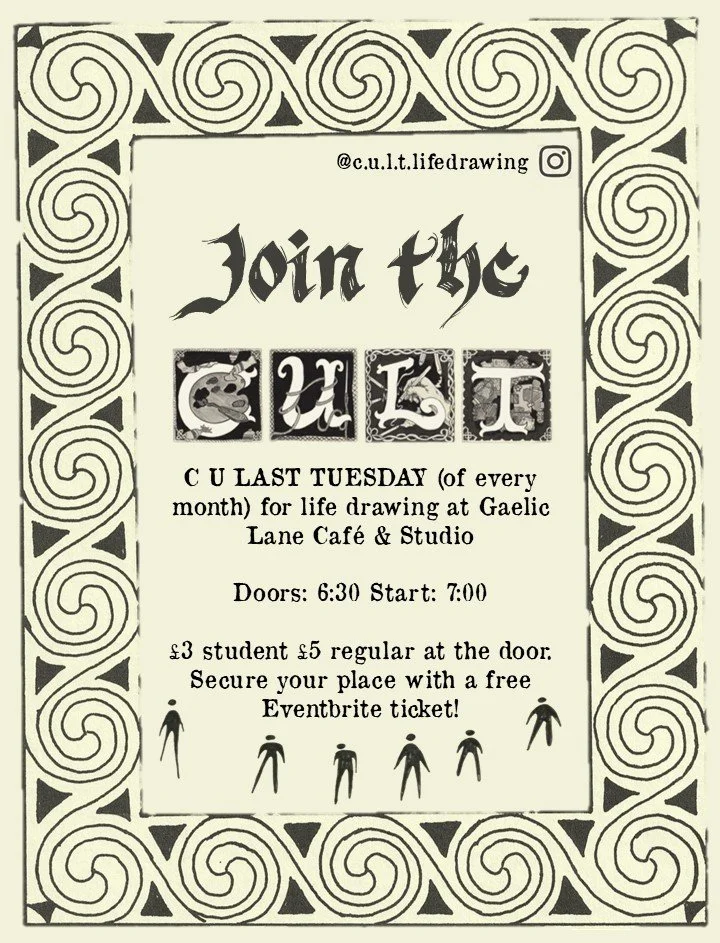
Poster by Lucy
Q: All be it a long-standing art form, people may have strong opinions against drawing of the naked body. What would you say to opinions like this?
Lucy: From an art historian’s perspective, life drawing and works of the ‘nude’ have been a staple in the industry. Museums and galleries don’t censor the bodies on display in works, but they have been controversial. I have written my dissertation covering the topic of female nude vs female nakedness through the lens of art history and asexuality. This research has taught me that art modelling, life drawing, and works of nudes have this air of sexual nature surrounding them when most of the time they shouldn’t. As I believe it, the act of nudity is asexual.
The word nude holds privilege as it is used as a term for “high-class art”. Therefore, the nude holds power as you change the way the body is perceived by yourself and others. The nude is untouchable and powerful because the person/body is confident. A quote from Helene Cixous’ 1976 ‘The Laugh of Medusa’ that conveys this idea really well is: “Censor the body, and you censor breath and speech at the same time. Write your self. Your body must be heard.”
Through this, I believe that it is important to see and study the body as it is the best way to learn how to draw it, but to also become confident in your own skin as every body is different and that is the beauty of them all, there is nothing else like it, like snowflakes. As many others and I view it, life drawing is an asexual task, and the strong opinions against life drawing need to experience it to fully understand what life drawing is and its importance for education.
Vanessa: I believe drawing the body is one of the most difficult things to draw, particularly from life. The way it stands and holds weight on different limbs, different forms and textures, coupled with lighting, I think it’s an excellent way to improve your drawing skills. Having the model naked allows you to fully comprehend its shapes. People who haven’t life drawn feel like it can be quite awkward, but it is so unsexy, and you kind of forget they are naked and see them as themselves.
I also feel like life drawing has improved my body confidence, seeing real naked people can steer you away from misconceptions of how you are “supposed” to look.
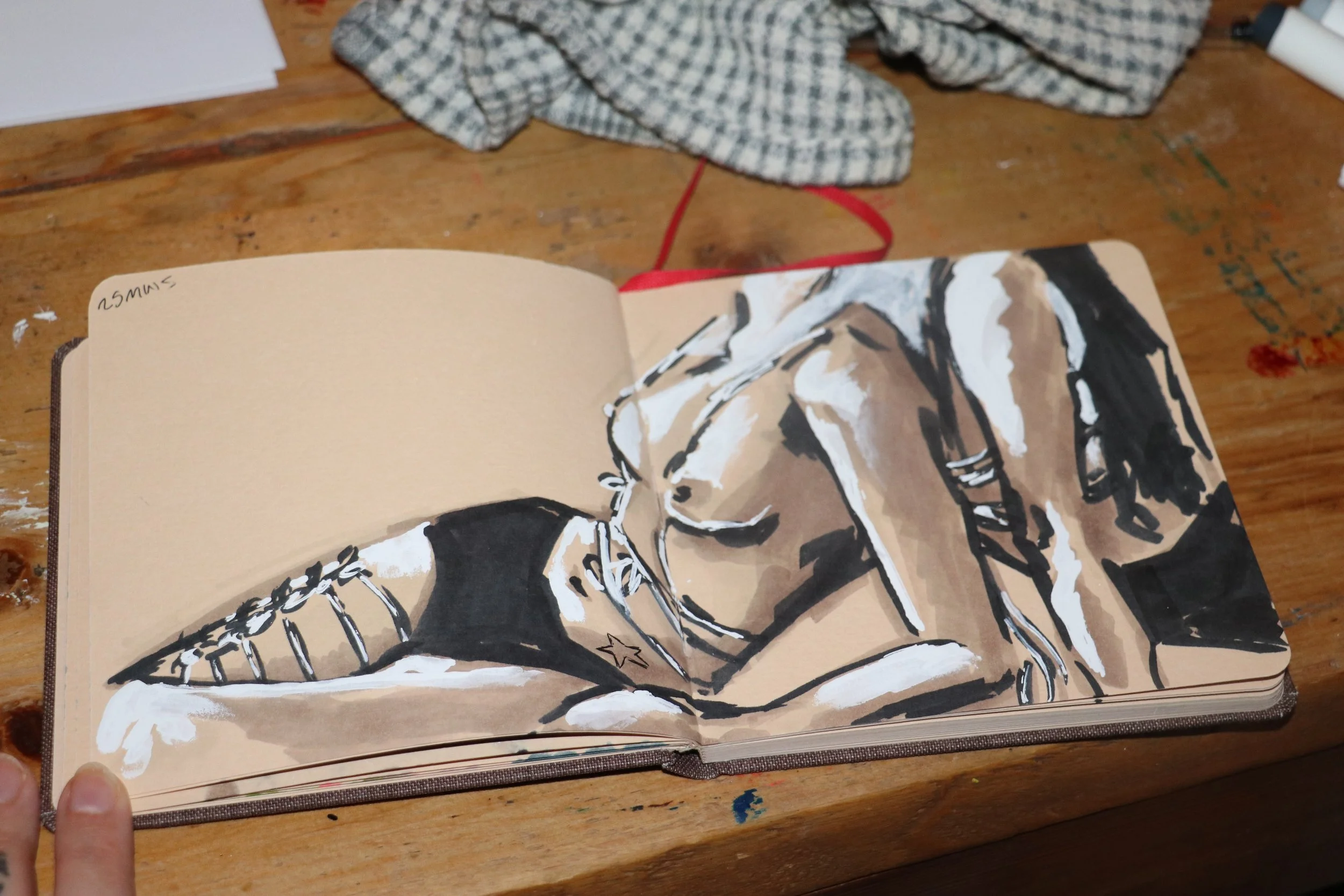
Drawing by Michaela Snow
Q: Disobedient Magazine is all about how art can be used as a form of resistance and expression, how do you believe your classes do this?
Lucy: We are trying to make life drawing “low-brow” as an art form. It has been limited to who could do it, and there were stigmas surrounding people, especially women who modelled. For example, at the Royal Academy in London, women could not attend life drawing classes and had to learn from busts and statues. It was not until 1893 that women could draw a live and heavily clothed male model. The men who did attend these classes often drew the male figure following the Renaissance belief of the ‘perfect’ male body from Da Vinci’s ‘Vitruvian Man’. To study the live female figure, you had to be over the age of 20 or married, as they believed the women who modelled for them to be prostitutes and often referred to what the models were paid as ‘shame’ money.
Today, this belief has changed, and through C.U.L.T, our sessions are open to anyone 18 and over who wants to access affordable art classes. Everything is handled with positivity and friendliness, and we have created a really nice community (or a cult, if you will) of artists at all levels and life experiences who just want to relax and draw. I believe that is a nice form of resistance, as it is no longer as restrictive as it once was in the past.
Vanessa: Coming from an art school background, life drawing is something all courses participate in, from where I came from, that was design, painting, and sculpture. It is a rite of passage to do multiple sessions in uni. If you haven’t done it, it lessens your legitimacy as an artist. But many people, particularly the working class, don’t have access to life drawing classes. And if they do, they are expensive or come with an air of snobbery that would turn them away. We want to challenge that, learning to draw in a fun environment can be for everyone. Most models we get are women, but we want to include trans and masculine bodies as well to create a variety of drawings.
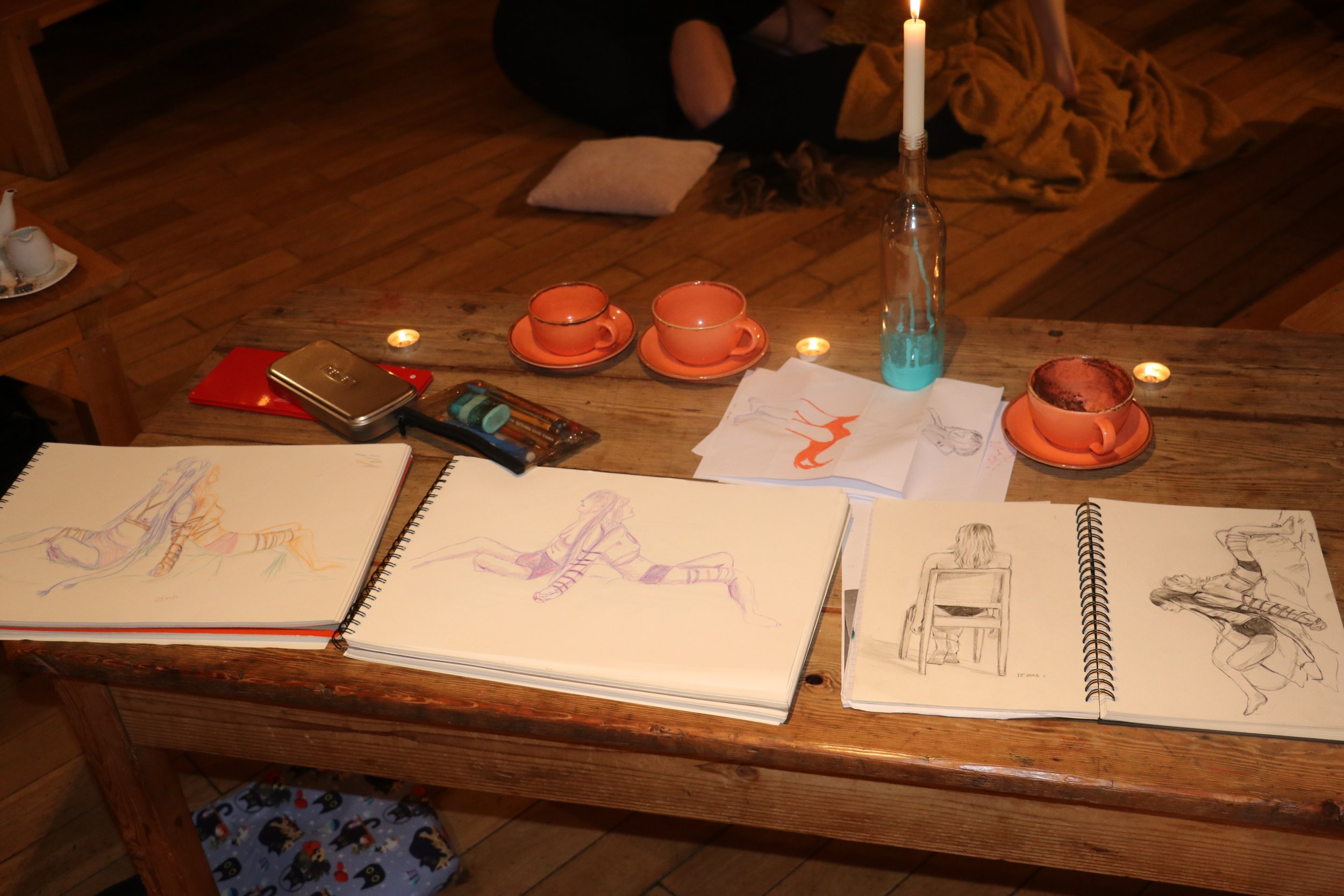
Collection of drawings by “Cultists”
Q7: What reasons do you think people may have that are making them hesitant to join your classes? What would you say to them to encourage joining in?
Both: Honestly, probably just the nudity, but as said before, it's just a stigma and can be seen as off-putting. But we would like to highlight that it has changed from what it was in the past. We have no judgment on the bodies, and we do not judge the art people make of said bodies. It feels kind of rude and wrong to say, but if the nudity makes you nervous, you will forget they are naked and start to view them as light, shadows, and shapes for you to draw.
Some people might be worried about drawing in a public setting, as making art can be vulnerable and personal. But we do not require anyone to share what they are working on, and you should not compare yourself to others. Be inspired by them instead! We also want to celebrate the very fact that you went out of your way to make art that evening. It’s a great way to unplug and be social.
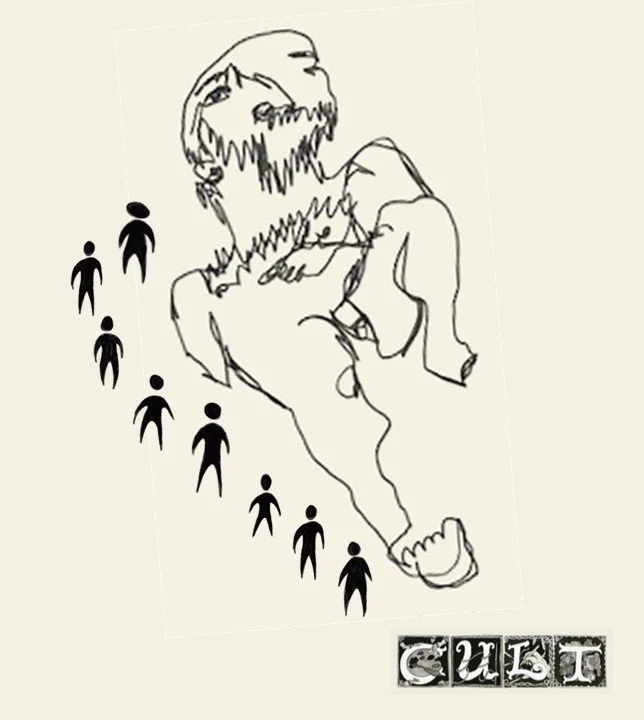
Drawing by Lucy
Q: Can you run us through what a class looks like, start to finish?
Both: You get yourself comfortable in our big oval of tables, and you are free to get a drink from the brilliant Gaelic Lane Cafe staff.
Once everyone is settled, we put on some chill music, lock the door, and begin our warm-up poses that ease everyone in. These are usually 5 × 1 mins.
Then our longer poses, 2 × 15 mins, then a break. After that, a 10min pose to break up the break, then our longest pose of 25 minutes. As the poses get longer, the model begins standing, then sitting, then, for our longest pose, lying on a beanbag - which we have been told is very comfy. We make sure to keep track of the model’s rotation so different people can get different angles within the circle.
After that, the doors are unlocked, and attendees are free to leave, but a lot stay to socialise and show off work to peers, us, and the model. If people allow us, we will take pictures of their work for our social media through “Cultist Tuesdays”. We love seeing people's work.
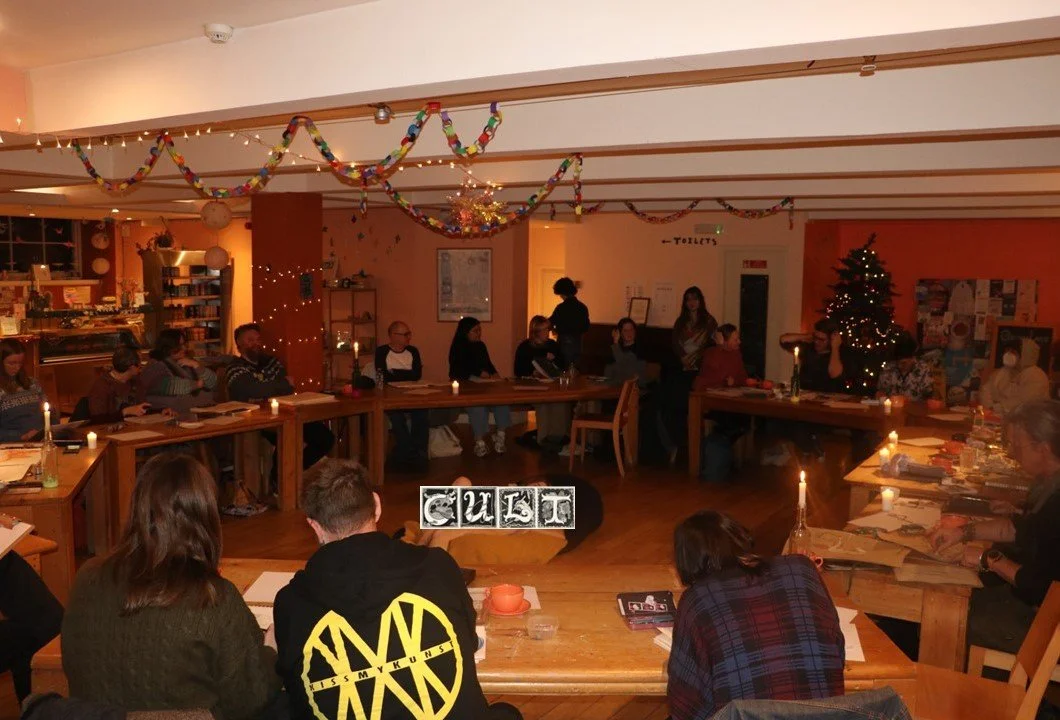
CULT class
You can join Vanessa and Lucy at one of their sessions on the last Tuesday of every month at Gaelic Lane Cafe, Aberdeen. Costs are £3 for a student and £5 concession.
